


How to Stop Cravings: The Science Behind Urges and How to Control Them (with Breath!)

If you’ve ever tried to stop a craving, you’ve probably noticed something frustrating. It doesn’t feel like a simple thought you can ignore. It feels physical. Your attention narrows, your body shifts, and there’s a sense of urgency that builds quickly. In those moments, it can feel like the decision has already been made before you even have time to think about it.
This is where most people get stuck. They assume cravings are a mental problem, so they try to solve them with mental tools...or just think their way out. They distract themselves, negotiate with themselves, or rely on willpower. Sometimes that works temporarily, but often it doesn’t last. The reason is simple. By the time you’re aware of the craving, your body has already changed.
If you want to understand how to stop cravings, you have to start by understanding what’s happening physiologically when they show up.
The Physiological Response of an Urge
Research from Rutgers University looked at what happens when individuals who struggle with addiction or habitual behaviors are exposed to visual cues related to that behavior. What they found is that the response is not just psychological. It is immediate and physical, and one of the first systems to change is breathing.
When a person encounters a cue tied to their habit, three consistent shifts in breathing tend to occur. First, breathing becomes faster. Second, it shifts upward into the chest instead of staying lower and more controlled. Third, it becomes irregular, losing its natural rhythm. These changes may seem small, but they have a significant impact on how the brain and body respond in that moment.
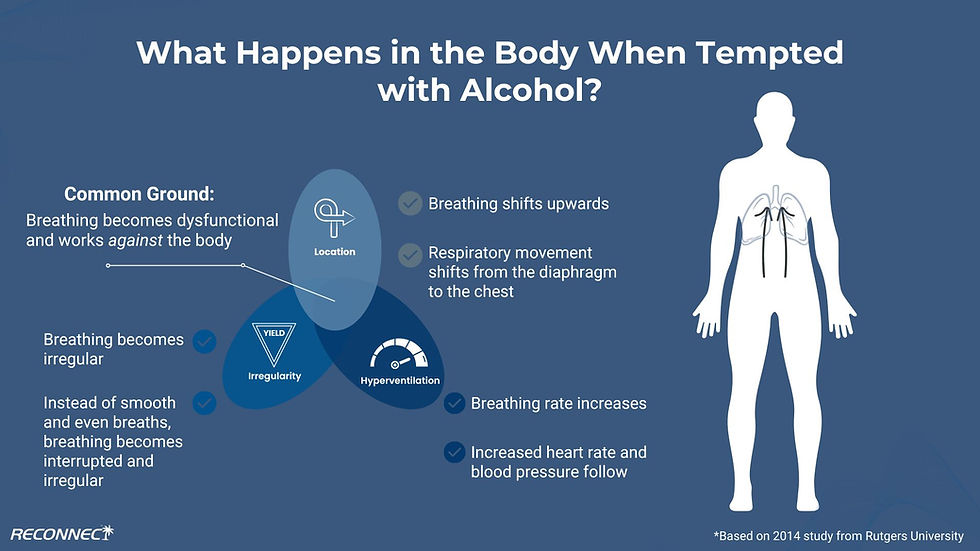
Breathing is directly tied to your nervous system. When your breathing becomes faster, shallower, and more erratic, it signals to your body that something important is happening. This shift increases activation in areas of the brain associated with reactivity and learned behavior, including the amygdala. The amygdala plays a role in emotional responses, urgency, and patterns that have been reinforced over time. When it becomes more active, your ability to pause and make a deliberate decision becomes more limited.
This is part of why cravings feel so strong. It’s not just that you want something. Your system is becoming more reactive and more prepared to act. The breathing pattern is helping drive that state forward.
This also explains why willpower alone tends to fail. Most approaches to stopping cravings assume that if you can just think differently, you’ll behave differently. But by the time you’re trying to think your way out of a craving, your physiology has already shifted into a state that makes clear thinking more difficult. You are essentially trying to override a full-body response with a single tool.
The Point of Intervention
A more effective approach is to intervene at the level where the shift is happening. Instead of trying to control the craving directly, you change the state that is fueling it. One of the most accessible ways to do that is through breathing.
When you slow your breathing down, especially to a consistent rhythm of around five seconds in and five seconds out, you begin to reverse the pattern that was triggered by the craving. The breath becomes slower, more controlled, and more rhythmic. This shift has a direct effect on your nervous system. It reduces reactivity and increases your ability to regulate your response.
Research has shown that slower, controlled breathing can improve impulse control and emotional regulation. In practical terms, this means that you are more capable of noticing the craving without immediately acting on it. The craving may still be there, but it no longer has the same intensity or urgency.
This is an important distinction. The goal is not to eliminate cravings entirely. That’s not realistic, especially if the behavior has been reinforced over time. The goal is to change your relationship to the craving so that it no longer dictates your behavior.
When you use your breath in this way, you create a small but meaningful gap between the urge and your response. That gap is where decision-making becomes possible.
A simple way to apply this is to use a controlled breathing pattern as soon as you notice a craving starting to build. Inhale slowly through your nose for five seconds, then exhale slowly for five seconds. Keep the breath smooth and consistent, without forcing it. Continue for a few minutes. As the breathing stabilizes, your internal state begins to stabilize as well.
Here's a guided breath track you can use for urges
What you’ll often notice is that the craving shifts. It may become less intense, or it may simply feel more manageable. Either way, you are no longer being pulled in the same automatic way. You have more space to decide what you want to do next.
Over time, this becomes a skill. The more often you interrupt the pattern at the physiological level, the less automatic the behavior becomes. You are not just resisting the craving. You are changing the conditions that allow it to take over.
This is where breathwork becomes more than just a relaxation tool. It becomes a way to influence how your system responds in moments that matter. Instead of waiting until the craving has already escalated, you learn to recognize the early signals and respond differently.
Understanding how to stop cravings isn’t about finding a single technique that works every time. It’s about recognizing that cravings are part of a larger system that includes your brain, your body, and your breathing. When you address that system directly, your options expand.
Most people focus on what they should or shouldn’t do when a craving appears. A more effective approach is to focus on what state you’re in when that craving arises. Change the state, and the behavior becomes easier to change as well.
Breathing is one of the fastest ways to do that.
To learn more about breathwork for addiction, visit our website and check out our courses. If you really want to dive in and become certified, join our Instructor Training and learn our 3-part framework on how to guide others out of dysfunctional breathing patterns and into better self-control and emotional knowledge.
Kevin Connelly, founder of Reconnect

Kevin is an author, researcher, and breath expert who's led thousands of wellness enthusiasts through breathwork and ice bath experiences in Mexico and around the world. He is one of the leaders in breathwork-related research and conducts studies on the effects of breath on the heart and brain. Kevin delivers breathwork and cold exposure trainings for retreats, corporate events, and businesses worldwide.


Comments